Oak wilt is a serious problem in central Texas. It kills neighborhoods worth of trees at a time. Implementing control programs is crucial, but implementing programs to plant replacement trees is arguably more important. But, what kind of trees should be planted?
Lately, the popular choices have been wilt resistant oak species: bur oaks, chinquapin (cheenk-a-pen) oaks, monterrey oaks and lacey oaks. While these are all reputable trees, they are not without their own limitations. Bur and chinquapin oaks in their natural setting are found in river bottom areas where there is substantial water available in the underground tables. Planting these trees in the hill country or on a rocky slope is not a good idea without irrigation; even then, you are testing mother nature’s boundaries. Monterrey and lacey oaks are better adapted to rocky slopes and dry conditions, but you should know that these are not tall growing trees. Monterreys get a little taller than the laceys, but both max out around 15-20 feet. And, their life span is relatively short as well. Depending on planting conditions, you should expect 20-40 years. Maybe that’s long enough for you, but come on, you are going through all the trouble to plant a tree; why not plant something that will grace the neighborhood long after you move on.
My favorite trees to plant are the natives, even the ones people shun because of oak wilt susceptibility. Live oaks and red oaks are two of the best adapted varieties of trees for the central Texas area, but many people write them off because of oak wilt. The reality is that transplanted oaks generally don’t graft roots with the natives and will survive an oak wilt onslaught. Cedar elms are another good choice for central Texas, and these trees are hardy to a large variety of growing conditions.
Live oaks and red oaks are the best trees for the area. It’s bad enough that oak wilt is killing them. We don’t the to make the problem worse by failing to replant these spectacular species. Basing your planting selection on one single tree disease is succumbing to evil’s trickery. Just because a tree is tolerant of oak wilt, doesn’t mean it won’t have other problems. And, oak wilt control is getting better all the time. With the digital age upon us, documentation and our knowledge base is improving. Mark my words, one day soon, we will be able to effectively treat and control oak wilt. Help restore our oak forests by planting new live oaks and red oaks today.
What is the best fast growing shade tree to plant in Austin? Here is my answer: red oak. There are several factors that must be considered, and there are special precautions you need to take. No tree is fool proof.

Red oaks grow fast to provide shade quickly, plus they are long lived and hardy. Here is a red oak 6 years after planting
The general trade off for fast growing trees is that they are shorter lived and require more maintenance, but you get shade faster. And, typically, slower growing trees live longer and tend to require less maintenance in a typical urban landscape. The red oak is a good balance. This tree has a rapid growth rate, 3-4 feet per year, and has a solid wood you would expect from an oak which makes them less prone to limb failure during storms. The norm for fast growing trees is that they have weak wood that require regular canopy thinning to reduce the likelihood of limb failure. Red oaks require very minimal pruning throughout their life, comparatively.
You do need to pay special attention to red oaks during the first few years after planting your new red oak. These trees are especially susceptible to transplant shock. Keep in mind that they have spent the first few years of their life in a tree farm that has maintained perfect growing conditions to grow trees fast. So your tree has just been relocated from a tree utopia to the virtual desert that is your yard. It is important to water and fertilize your tree properly during the first 1-3 years (read our fertilizer blogs).
Get past the first few years and you will have a fast growing shade tree that will grace your neighborhood for 75 years or more. In as little as 6 years you will have a tree that really looks like a tree, not just a stick in your yard.
There are two basic categories you need to address when it comes to tree selection. What is the best tree for your planting site and how to pick a quality specimen. You need to get these two things right or all you labor will be for nothing.
bud scale scar
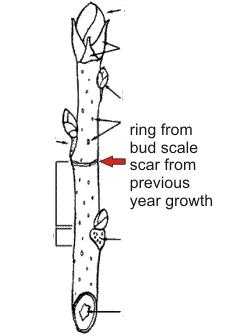
Lets start with selection of a quality tree. Let’s start by looking at the leaves. The deeper green the color the better the leaf. Unfortunately, this technique is only completely reliable in the spring. If you are looking in the summer or fall this will be deceiving because the trees may be going through normal leaf drop or heat stress. You shouldn’t plant in the summer anyway, so you shouldn’t be looking then. If you are trying to find a tree in the fall, look at the bud scale scar. More distance between these scars indicates more growth, which can be an indication of healthier trees (or better
fertilizer). This only works when you are comparing trees of the same species.
The next thing to look for are trunk wounds. Don’t buy anything with injuries on the trunk.

The tree on the left will have good structural growth. The tree on the right is more likely to have breaking limbs in the future.
Growth form is another important factor if you are looking for a large growing shade tree. You want a tree with a single trunk all the way to the top. Think Christmas tree. Often, there will be a biforcation (joint) in the lower part of the tree and you will have a “double leader.” This is basically two main trunks. These trees will have structural integrity problems in the future.
Picking the right kind of tree for the right place can be tricky. For this part I highly recommend consulting with your arborist. You need to be careful taking advice from the nursery. They don’t know where you live or what your site looks like. There are a few important topics to discuss with your arborist.
- Do you want a small ornamental tree or a large shade tree or something inbetween?
- Is the tree going to be pampered or thrown to the wolves? (auto-irrigation, fertilized regularly)
- What other landscape changes do you want to make around the tree’s planting site?
Follow these steps and you should wind up with the right kind of tree and a nice looking specimen.
Planting a tree is slightly more complicated than digging a hole and sticking a tree in it. But, not too much more complicated. Follow these few tips and your new tree will be sheltering you from the sun in no time. And, by that, I mean in a few years.
The first step is to pick a tree, but that is another blog. Once you have the right tree it’s time to find the right place to plant it. The rookie mistake here is to look around at the ground to find your spot. LOOK UP! You want to find a place where adjacent trees’ canopies won’t be crowding your new tree too much. You want an open view of the sky from your planting spot.
Now it’s time to start digging. The depth of your planting hole should be the exactly the same as the root ball of your new tree. If you hit bedrock and can’t go deep enough, this is okay. However, if you plant the tree too deep it will be certain death. When you can’t dig deep enough, just mound the soil around the root ball and add a little more mulch than you normally would to help insulate. Do not chip a hole in the rock to plant. This hole in the rock will not drain water and will become a cesspool of root disease. For width, make the hole about 12” wider on all sides than the root ball so you have room to add fill soil around the root ball.
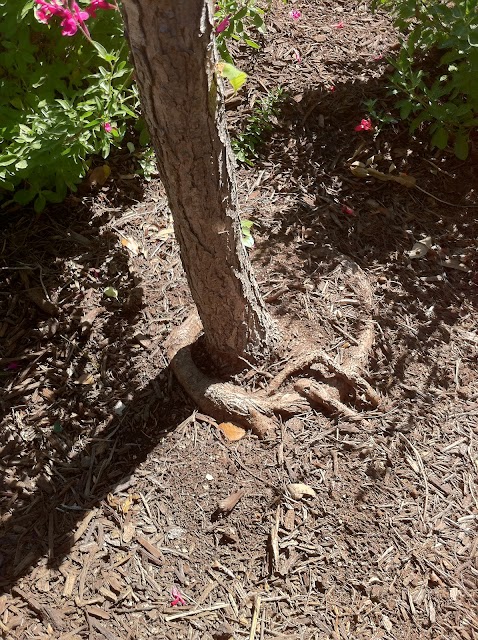
Before you put the tree in it’s new home you need to prepare the root ball. Most people have a hard time with this. Normal instinct is to be very cautious with the precious roots, but what you really need to do is tear them up. Trees sitting in a container at the tree farm end up with roots growing in circles around the edge of the container. We need to loosen or cut these roots or we’ll end up with girdling roots in 10 years and you’ll be wondering why your tree randomly died.
Now it’s time to stick your tree in the hole. But, first double check to make sure that your root ball and hole depth are still the same. Tearing up the root ball may have changed this. Throw some dirt in the hole if needed to bring the top of the root ball to surface level. Now that your tree is in the hole, throw some dirt around the edges to fill the hole. I like to mix some of the native clay with some sand, topsoil, and mulch, but you can get away with just using the dirt you pulled from the hole or topsoil from the local garden store or nursery. Top with 3-4” of mulch and you are good to go.
Water the tree thoroughly before putting the mulch down and water it every three days for the first 6 months.