
Mulching & Composting in Austin
Composting as Tree Care
There are very few things as effective at improving long-term tree condition as composting. If your tree’s root zone is covered by turf, a 3/4-inch layer of compost can be spread across the lawn—within a few weeks it settles into the soil. The lawn benefits greatly from the compost as well. If you have garden areas around the tree, top off the mulch every spring and fall. Austin Tree Experts recommends February/March and September/October as the best times to target application, just before or at the start of each growing season.
Compost feeds the soil biology that trees depend on. In Austin’s thin, alkaline soils—especially the limestone-heavy ground west of I-35 and the heavy clay east of it—organic matter breaks down fast. Regular compost applications replace what’s lost and steadily improve soil structure, water infiltration, and nutrient availability. It’s one of the best investments you can make in your trees’ long-term health, and it pairs perfectly with a fertilization program.

Proper Mulching: Depth & Area
In turf areas, you can’t apply more than about 3/4 inch of compost without smothering the grass. That’s a good amount and will do wonders for the soil, turf, and trees. Mulch beds should be maintained at 3 to 4 inches deep. The first application to a new or eroded bed should go down at about 5 inches, then top-up applications usually require 2 to 3 inches to maintain thickness.
The area needs to be large enough to matter. A 3-foot ring around the trunk of a mature tree is mostly cosmetic—it’s not a big enough area to meaningfully impact the tree’s condition. There’s no hard rule, but an area less than 20 feet in diameter is starting to get quite small for a mature tree. New trees need the treated area to expand a little every year until you reach a useful size. Use our Mulch Calculator if you need help figuring out how much material you need.

Our Mulch vs. the Others
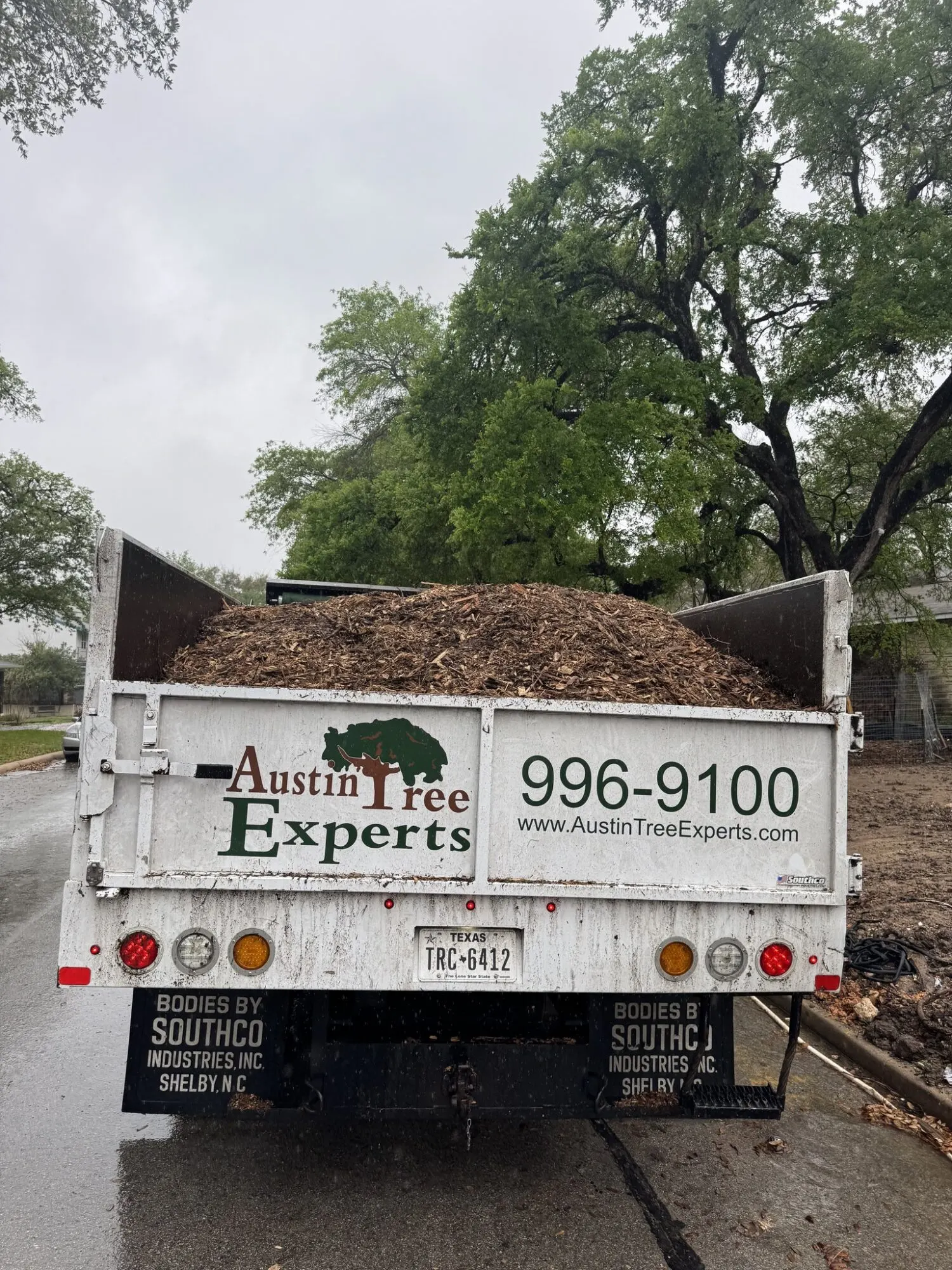
Most mulch you get from landscapers and landscape suppliers is double-ground, screened to remove the compost, and colored to produce a product that’s very uniform in size and color. To many people, this looks best—and that’s why it’s popular. The mulch we make is different. We don’t screen out the fines (compost), and we don’t add color. It’s a more natural-looking mulch, and we think it’s better for the trees because it retains the nutrient-rich compost that feeds the soil as it breaks down.
All of our mulch is made from trees we’ve removed and pruned across Austin. It’s a true closed-loop process—the trees we take care of become the mulch that helps the next generation of trees thrive.
When to Mulch or Compost
Spring and fall are our two active growing seasons in Central Texas. Austin Tree Experts recommends getting the mulch down just before or during the very beginning of these seasons—February/March for spring and September/October for fall. Mulching before the growing season locks in moisture and gives the soil biology a head start.
How Much Does Mulching Cost?
There are three factors that determine the cost of mulching and composting:
- Material — We make our own mulch right here at our yard, so it’s very cost-effective.
- Delivery — Distance has some impact on cost, but our advantage is that the mulch is right here where we dispatch from. We match the truck to the job: an 18-yard mulch dump body for smaller residential deliveries, a 40-yard mulch dump body (one of the largest in Austin tree-service hands) for bulk commercial jobs, and our Mack roll-off grapple truck when the site needs its own loading rig. All mulch bodies mount to our Switch-N-Go trucks, so we can swap to the right capacity without dispatching a second vehicle. Delivered product typically ranges between $10 and $20 per yard depending on how much you order and where you’re located.
- Labor for spreading — We account for the crew spreading and raking it out. For large-volume orders, we bring a Caterpillar IT14 wheel loader or our Yanmar Vio55/SV100 excavators to move material fast, plus a Giant G1200 articulating loader or Boxer 320 mini skid steer for tight access around beds and drives. Circumstances vary greatly, so it’s hard to quote a range without knowing the details of your property.

Airspading Before Mulching
When providing a new layer of mulch, we’ll often want to use an air-spade to break up the top few inches of compacted soil. This helps the mulch grab the ground and resist washing away during heavy Central Texas rains. It can be very beneficial to mix in some compost to the air-tilled layer before spreading the mulch on top. This combination of soil decompaction, compost incorporation, and a fresh mulch layer is one of the most effective treatments we offer for trees with declining health.
Frequently Asked Questions About Mulching
How deep should mulch be applied?
Maintain mulch beds at 3 to 4 inches deep. First-time applications to bare ground should go down at about 5 inches to account for settling. Top-up applications usually need 2 to 3 inches. In turf areas, compost should not exceed 3/4 inch or it will smother the grass. Keep mulch pulled back a few inches from the trunk—piling mulch against the bark creates moisture problems.
What type of mulch is best for trees?
Natural, uncolored mulch that retains its compost fines is best for trees. Dyed mulch and rubber mulch add nothing to the soil. Our mulch is made from trees we’ve removed and pruned across Austin—it’s a natural product that breaks down and feeds the soil biology. For top-dressing lawns, we recommend aged compost rather than mulch.
How much mulch do I need?
Use our Mulch Calculator tool to figure out how many cubic yards you need based on the area and desired depth. As a rough guide, one cubic yard of mulch covers about 100 square feet at 3 inches deep. Our team can also estimate the quantity during a site visit.
How often should mulch be replenished?
Top up mulch beds twice a year—in February/March and September/October—to maintain proper depth heading into each growing season. In Central Texas heat, mulch decomposes relatively quickly, which is actually a good thing because it’s feeding the soil. Regular top-ups keep the benefits going.
Do you deliver mulch only, or also install it?
Both. We offer delivery-only if you prefer to spread it yourself, or full-service delivery and installation. For large jobs, we bring a loader to move material efficiently. Delivered product runs $10 to $20 per yard depending on volume and distance. Labor for spreading varies by site conditions.
Can mulching help a struggling tree?
Absolutely. Mulch moderates soil temperature, retains moisture, and feeds beneficial soil organisms. Combined with air-spade soil decompaction and a fertilization program, a proper mulch application can significantly improve a declining tree’s condition. It’s often one of the first things we recommend in a tree care plan.
Related Tree Services
- Tree Care & Fertilization — mulching and compost work best as part of an overall care program
- Air-Spade Services — soil decompaction and compost incorporation for compacted root zones
- Tree Planting — newly planted trees need mulch from day one
- Stump Grinding — reclaim stump sites with fresh mulch or new plantings
- All Services — explore everything Austin Tree Experts offers
Order Mulch or Schedule a Consultation
We make our own mulch and compost right here in Austin. Whether you need a few yards delivered to your driveway or a full-service installation across your property, we can help.
Call us today: (512) 996-9100