
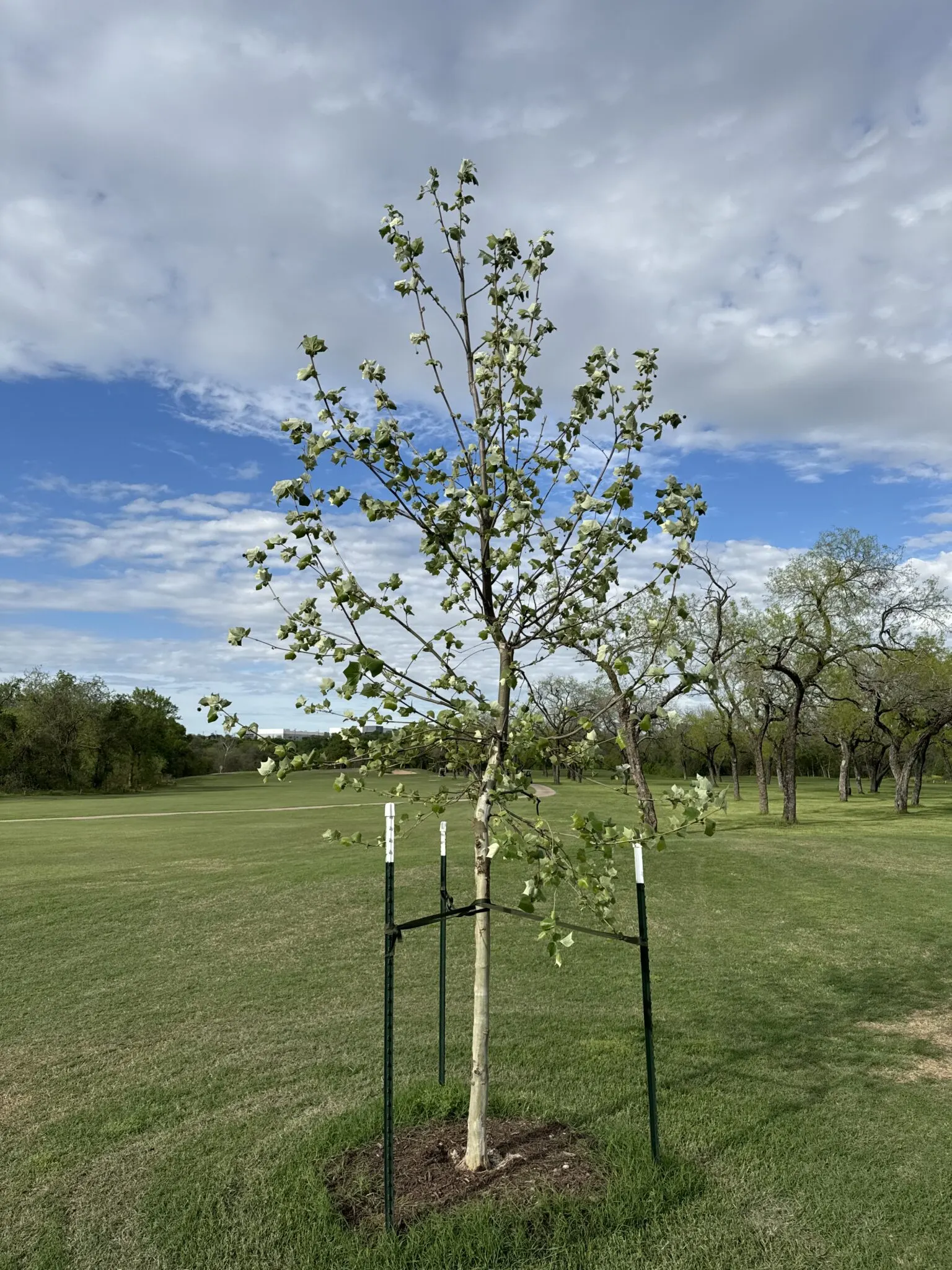
Tree Planting in Austin
We specialize in planting native and adapted trees for Central Texas. No minimum—we’re happy to plant that one special tree for your front yard. We’re also equipped to tackle large commercial planting projects or orchard installations. Whether you’re replacing a tree that was removed, satisfying a construction permit mitigation requirement, or simply adding shade to your property, Austin Tree Experts handles the entire process from species selection to installation.

Species, Planting Location & Sizes
These are the three decisions to make before any planting project. Contact us for a current tree planting info sheet that includes prices based on tree size and our recommended species organized by category: shade, privacy, and ornamental. We source from quality nurseries and inspect every tree before it goes in the ground—nursery stock quality varies widely, and a poorly grown tree will struggle no matter how well it’s planted.
Species we commonly plant in Austin include live oak, red oak, cedar elm, chinkapin oak, Mexican white oak (Monterrey oak), crape myrtle, desert willow, and Mexican buckeye. We steer clients away from species that don’t perform well in Austin’s alkaline soils—like pin oak, sweetgum, and some maple varieties—to avoid long-term problems with chlorosis and decline.
Consultations
Whether you need help figuring out the best tree to plant for shade in your front yard or need advice on planning a large park or neighborhood entry, we can help you make decisions that will lead to success. Sometimes the process is easy and there’s one obvious choice. Other times there are a few good options to weigh. To get there, we take into consideration the soil profile, site slope, irrigation availability, sun exposure, airspace competition, and your personal preference.
If you’re planning a construction project that will require mitigation plantings, our consulting arborists can work directly with your design team to select species and locations that satisfy the permit while also making sense for the long-term landscape.

Planting Season
For deciduous shade trees, Austin Tree Experts recommends planting in the late fall and winter—roughly October through February. Evergreen trees do especially well when planted in the spring. These are recommendations, not hard rules. We’ll often plant outside these windows as long as circumstances warrant it, and we’ll let you know during the consultation process what to expect.
Planting during the cooler months gives the root system time to establish before the stress of an Austin summer. Trees planted in spring or summer can succeed, but they require significantly more watering attention and may not carry the same warranty protection through their first hot season.
New Tree Care
The first two years after planting are critical. Here’s what your new tree needs:
Watering — Watering needs vary seasonally. If you plant in the late fall or winter window, you may not need to water more than once a month—or not at all if it’s raining. In early March, trees start breaking bud and watering should increase to once or twice per week. By May, when days are longer and temperatures are consistently hot, watering needs to increase to three to four times per week. The first summer, your tree will need daily watering. As temperatures drop in fall, taper back down. Your tree will require considerable irrigation for the first two years. After that, you should be able to lean on your regular watering schedule. For sites without established irrigation—a newly graded lot, a commercial mitigation planting, a hillside install—we can run establishment watering from our truck-mounted 600-gallon tree sprayer so new trees get a heavy soak during the critical first weeks.
Mulching — We’ll mulch the tree at planting. We recommend topping up the mulch every spring and fall. This is critical the first two years while roots are getting established—mulch keeps soil temperatures moderate, retains moisture, and feeds the soil biology.
Pruning — Trees shouldn’t be pruned the first year. The first pruning is typically around year three. Pruning should be limited to structural work—encouraging a central leader by reducing aggressive scaffold limb growth. Canopy raising should be minimal or not done at all early on.
Airspading for girdling roots — Around three to five years after planting, we recommend excavating the root flares with an AirSpade and pruning away any girdling roots. Girdling roots are an inevitable part of planting trees that spent their first few years of life in a container. Performing root pruning after the tree is established and growing vigorously will greatly reduce future problems and extend the lifespan of the tree. Our AirSpades run off a truck-mounted Kaeser MU210 compressor or a towable Ingersoll-Rand 185CFM—the same rig we use when digging near marked underground utilities on new-construction planting sites, where mechanical digging isn’t safe until lines are exposed.

Equipment for Large-Scale & Commercial Plantings
A single shade tree doesn’t need much beyond a shovel and a crew. Commercial installs, orchard projects, and neighborhood entry plantings are a different job—they need speed, consistency, and the ability to move large root balls without damaging them. For those projects we bring hydraulic auger attachments mounted on our Giant G1200 wheel loader and Yanmar Vio55 excavator, drilling dozens of clean, uniform planting holes far faster than hand-dug labor. The Yanmar Vio55 or larger SV100 excavator also shuttles balled-and-burlapped stock around the site without compacting root balls, and a Boxer 320 mini skid steer handles precision placement in tight spaces between landscape beds and hardscape.
All of the heavy equipment rides to site on a 14-foot flatbed mounted to one of our Switch-N-Go roll-off trucks, which also lets us swap in the 600-gallon sprayer body the same day for initial watering before the crew leaves the site. That single-truck versatility is why we can handle a 200-tree orchard install or a mitigation project satisfying a construction-site permit with the same fleet that does a single oak in a front yard.
Mitigation Plantings & Construction Sites
Austin Tree Experts can prepare and execute any tree planting mitigation needs you may have to satisfy construction permit requirements. If you have a construction project in planning or active construction, take a look at our Construction Site Services page. We offer the full array of tree-related needs for tree ordinance compliance—from the initial arborist report through final mitigation planting and inspection.
Frequently Asked Questions About Tree Planting
When is the best time to plant trees in Austin?
Late fall through winter (October–February) is ideal for deciduous shade trees. Evergreens do well planted in spring. Planting during the cooler months gives root systems time to establish before summer heat. We’ll work with you on timing during the consultation.
What species do you recommend for Austin?
Live oak, red oak, cedar elm, chinkapin oak, Mexican white oak (Monterrey oak), crape myrtle, desert willow, and Mexican buckeye are all strong performers in Central Texas. We avoid species that struggle in Austin’s alkaline soils, like pin oak and sweetgum. Your arborist will recommend species based on your specific site conditions—soil, sun, space, and irrigation.
How much does tree planting cost?
Cost depends primarily on the species and size of the tree. Smaller ornamental trees are naturally less expensive than large caliper shade trees. The planting itself—digging, amending soil, staking, and mulching—is included in our pricing. Contact us for a current tree planting info sheet with specific pricing by size and species. Call (512) 996-9100.
Do you offer a warranty on planted trees?
Yes. Our warranty requires that you follow the approved watering protocol, get our pre-approval before applying any pesticides or fertilizers to the tree, and let our crews handle any pruning during the warranty period. Trees planted outside the recommended fall/winter window may not carry warranty protection through their first summer. Details are included in your planting proposal.
Why do newly planted trees fail?
The most common causes of establishment failure are underwatering (especially the first summer), planting too deep, and girdling roots from nursery containers. We address all three: our crews plant at the correct depth with the root flare visible, we provide a detailed watering schedule, and we recommend air-spade root pruning at three to five years to address girdling roots before they become a serious problem.
Can you plant where a tree was removed?
Yes. If the stump has been ground down, we can remove the remaining wood chips, backfill with quality soil, and plant in or near the same spot. If the previous tree was lost to oak wilt, we’ll discuss species selection carefully to avoid replanting a susceptible tree in an infected area.
Related Tree Services
- Tree Pruning — structural pruning for young trees starting around year three
- Tree Care & Fertilization — ongoing health programs to support newly planted trees
- Mulching & Composting — critical for new tree establishment and long-term root health
- Air-Spade Services — girdling root pruning at 3–5 years after planting
- Construction Site Services — mitigation plantings for permit compliance
- All Services — explore everything Austin Tree Experts offers
Get a Free Tree Planting Consultation
Our Certified Arborists help you choose the right tree for your property and Central Texas conditions. From a single shade tree to a large commercial planting project, we handle every detail.
Call us today: (512) 996-9100