
Shaded Fuel Breaks in Austin
A shaded fuel break is a strategically managed strip of land where trees and brush are selectively thinned to slow the spread of wildfire. Unlike a firebreak that removes all vegetation, a shaded fuel break preserves desirable trees while eliminating the ladder fuels—brush, dead branches, and dense understory—that allow ground fires to climb into the canopy. The result is a defensible space that’s both functional and aesthetically appropriate for residential and municipal properties in the Austin Hill Country.
Our Fuel Break Process
- Assessment — Our arborist walks the property to evaluate terrain, vegetation density, prevailing wind patterns, and proximity to structures. We identify which trees to preserve and which to remove.
- Selective thinning — We remove dead, diseased, and undesirable species (particularly Ashe juniper/cedar) while preserving healthy hardwoods and oaks. Thinning creates horizontal spacing between tree canopies to prevent crown-to-crown fire spread.
- Understory clearing — Brush, dead branches, and accumulated debris are cleared from the ground level. This eliminates the ladder fuels that allow surface fires to reach the canopy.
- Crown spacing & pruning — Remaining trees are pruned to raise the canopy above ground-level flame height and create separation between crowns.
- Disposal & mulching — We process cleared material on site or haul it back to our yard. Chips can be spread as mulch or removed entirely depending on fire risk assessment.
- Maintenance plan — Fuel breaks require periodic maintenance as vegetation regrows. We establish a schedule based on the growth rate of the understory and the property’s risk profile.

Wildfire Risk in Central Texas
The 2011 Bastrop Complex Fire burned over 34,000 acres and destroyed nearly 1,700 homes—a reminder that wildfire is a real threat in Central Texas, not just out west. The Austin Hill Country’s mix of dense Ashe juniper, steep terrain, and seasonal drought creates conditions where fire can move fast. Properties on the western edge of Austin, in Steiner Ranch, Spicewood, Bee Cave, Lakeway, and Dripping Springs are particularly vulnerable.
Ashe juniper (commonly called “cedar”) is one of the most flammable native species in Texas. Its volatile oils, shredding bark, and dense growth habit make it an ideal ladder fuel. A single juniper thicket can carry a ground fire into the canopy of the live oaks above it. Selectively removing juniper while preserving the oaks is the foundation of most fuel break work we do in the Austin area.
Residential & Municipal Applications
Fuel breaks aren’t just for rural properties. We install shaded fuel breaks for:
- Residential properties — Creating defensible space around homes in the wildland-urban interface (WUI). Many insurance providers offer discounts for properties with maintained fuel breaks.
- HOAs and neighborhoods — Managing common areas, greenbelts, and perimeter buffers along the community edge.
- Municipal parks and preserves — Balancing public safety with habitat preservation.
- Commercial properties — Protecting structures and reducing liability for properties adjacent to wildland areas.
Why Choose Austin Tree Experts
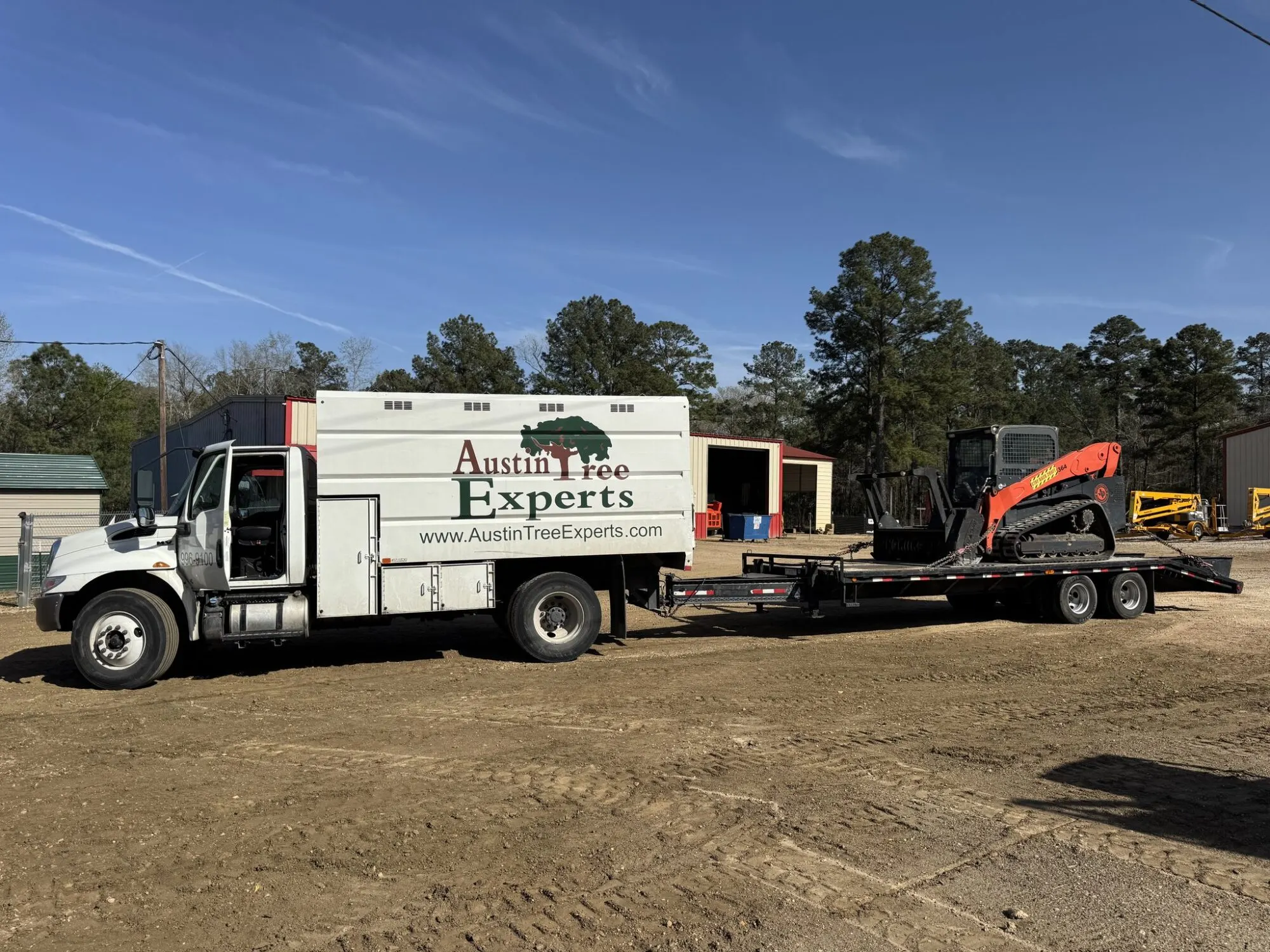
Fuel break work requires the right equipment and the arboricultural knowledge to decide what stays and what goes. For the volume of material a fuel break produces we bring our Peterbilt 340 grapple crane truck and Mack roll-off grapple truck for big wood; a Caterpillar IT14 wheel loader and two Yanmar excavators (Vio55 and SV100) with log grapple attachments for fast material handling on steep terrain; two Bandit wood chippers—a 15” and a 12”—feeding 23-yard chipper bodies mounted on our Switch-N-Go trucks. That combination means we process and haul juniper and brush in a single pass rather than making repeated trips. Our ISA Certified Arborists make the species and condition assessments that determine the thinning plan. We’re not a brush-clearing outfit that removes everything—we’re arborists who understand how to create effective fire protection while preserving the trees that give your property its value and character.
Frequently Asked Questions About Fuel Breaks
How wide should a shaded fuel break be?
Width depends on terrain, vegetation type, and proximity to structures. A typical residential fuel break is 30 to 100 feet wide. Properties on steep slopes or adjacent to dense juniper stands may need wider breaks. Our arborist assesses the specific conditions and recommends an appropriate width during the initial consultation.
Will a fuel break make my property look cleared or bare?
No. A shaded fuel break preserves desirable shade trees—it’s “shaded” because the canopy stays. The understory brush, dead material, and dense juniper thickets are removed, leaving an open, park-like landscape under a healthy canopy. Most homeowners find that their property looks significantly better after fuel break work.
How often does a fuel break need maintenance?
Most fuel breaks need maintenance every 2 to 3 years to address regrowth, especially juniper seedlings and understory brush. Properties with faster-growing vegetation or steeper terrain may need annual touch-ups. We establish a maintenance schedule based on your property’s conditions.
Do I need a permit for fuel break work?
If the work involves removing protected trees (19 inches or larger in the City of Austin), a permit may be required. Selective thinning of brush and smaller trees typically does not require a permit, but it depends on your jurisdiction. Our consulting arborists can determine the permitting requirements for your property. Check your jurisdiction with our Jurisdiction Finder.
How much does fuel break installation cost?
Cost depends on the size of the area, density of vegetation, terrain difficulty, and disposal requirements. Small residential projects are straightforward. Large-scale municipal or HOA projects with steep terrain and heavy juniper stands require significantly more equipment and labor. We provide free on-site estimates—call (512) 996-9100.
Can fuel break work be combined with other tree services?
Absolutely. Fuel break projects often include pruning of preserved trees, removal of hazard trees, stump grinding, and mulch application. Combining services during one mobilization is more efficient and cost-effective than scheduling them separately.
Related Tree Services
- Tree Removal — removing dead, hazardous, or undesirable trees as part of fuel break work
- Tree Pruning — crown raising and canopy management for preserved trees
- Mulching & Composting — processing cleared material into mulch
- Arborist Consulting — site assessments and management plans for wildfire risk
- All Services — explore everything Austin Tree Experts offers
Schedule a Fuel Break Assessment
Our ISA Certified Arborists evaluate your property’s wildfire risk and develop a fuel break plan that protects your home while preserving the trees that matter. Free assessments for properties in Austin and the surrounding Hill Country.
Call us today: (512) 996-9100