

Tree Removal in Austin
Most trees get removed for either hazardous conditions, dead or declining health, or construction activities. We can help you navigate the nuances of any of these circumstances. If you’re uncertain whether your tree needs to be removed or can be salvaged with proper tree care and monitoring, our ISA Certified Arborists can walk you through your options. Tree removal is an area where Austin Tree Experts really shines—we carry the largest fleet of specialized removal equipment in the Austin market, we’re fully insured with liability coverage and workers’ compensation, and every crew works to ANSI A300 and ANSI Z133 safety standards. We can execute really complicated and dangerous jobs in a way that keeps our people and the job site as safe as possible.

Hazard Tree Removal
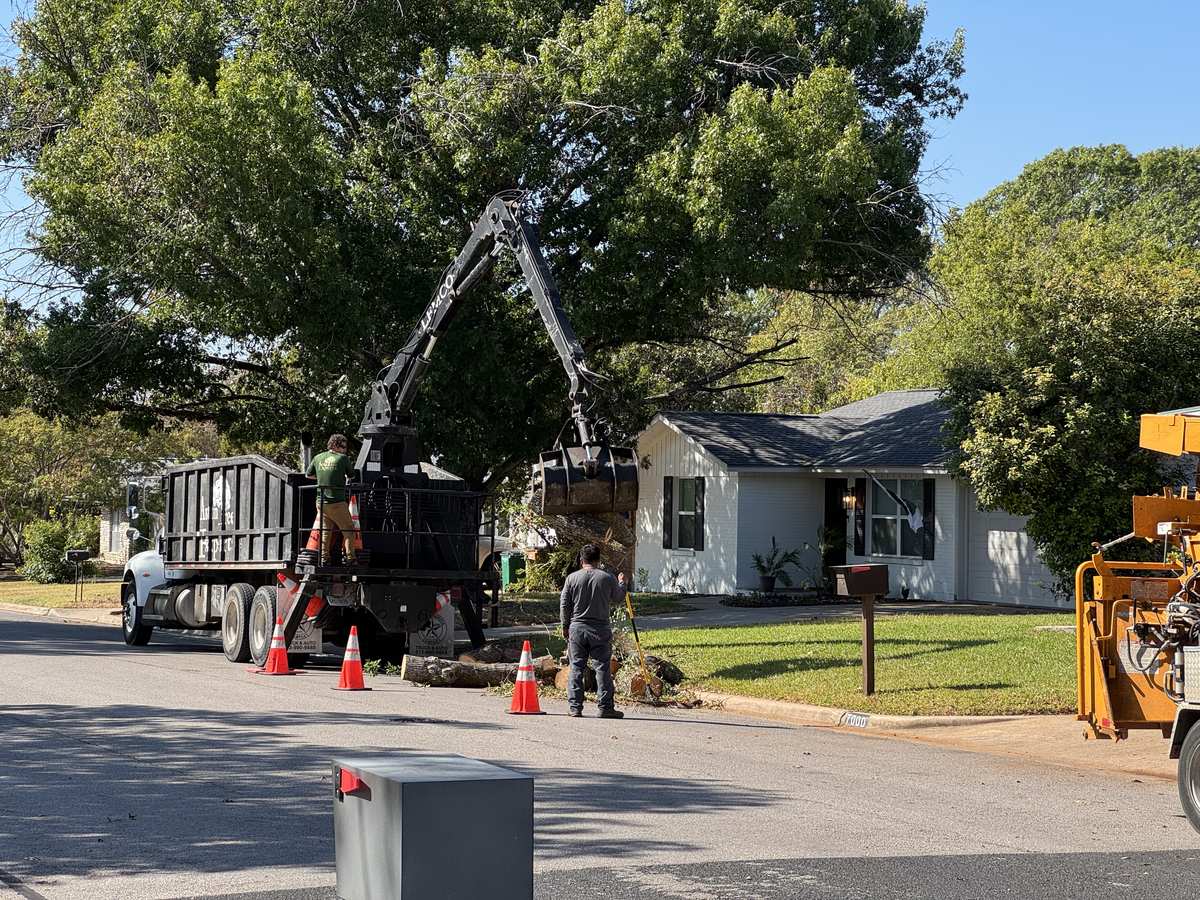
Hazardous tree removal leverages heavy-duty machines to minimize risk to tree workers and property. For big wood we run our Peterbilt 340 knuckleboom grapple crane truck and a Mack roll-off grapple truck; for ground-level material handling, two Boxer 320 mini skid steers, a Giant G1200 articulating loader, and a Caterpillar IT14 wheel loader; and for precision work in confined spaces, two Yanmar excavators—a mid-size Vio55 and a larger SV100—both fitted with log grapple attachments. When a tree is structurally compromised—leaning, split, or hollowed out—conventional climbing may not be safe. That’s when crane-assisted removal becomes the right approach: we can lift entire sections out of the canopy without putting a climber in a compromised tree.
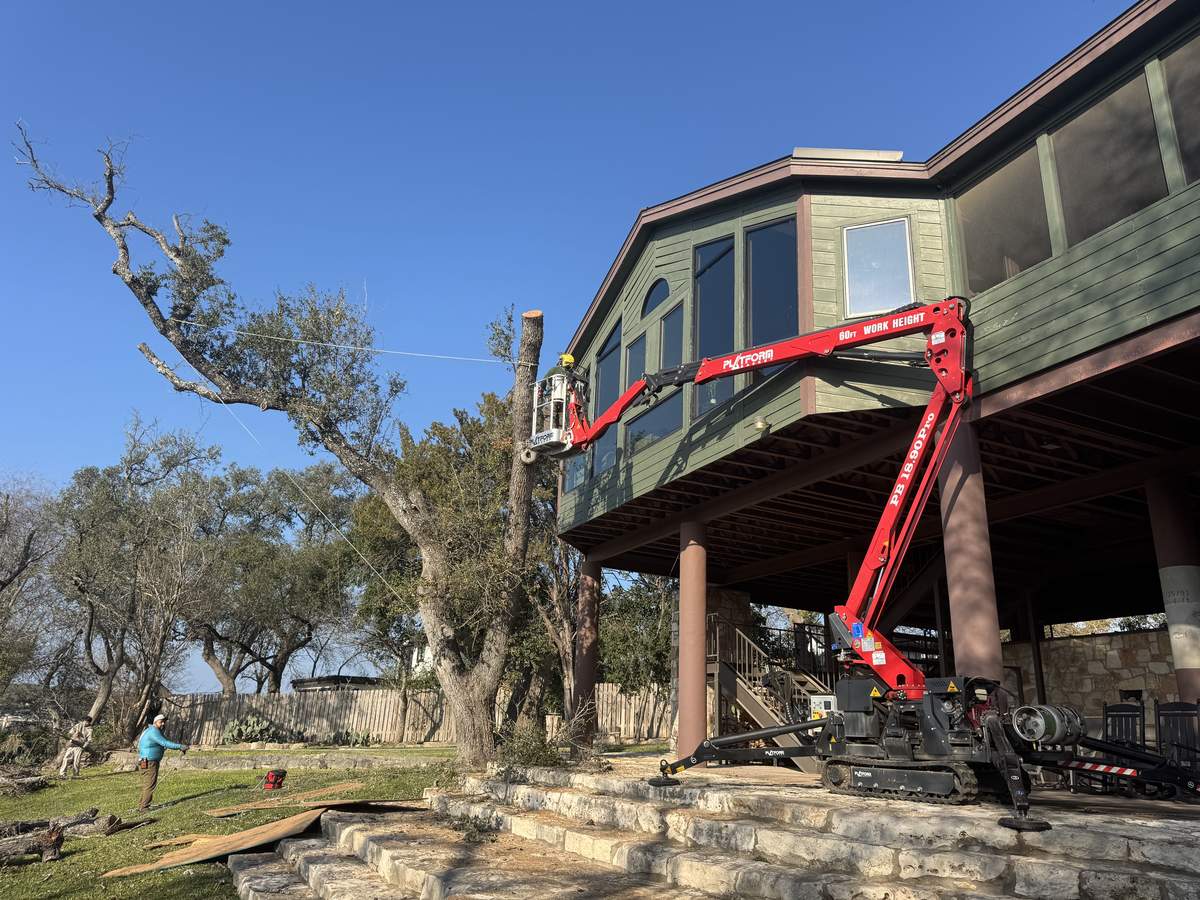
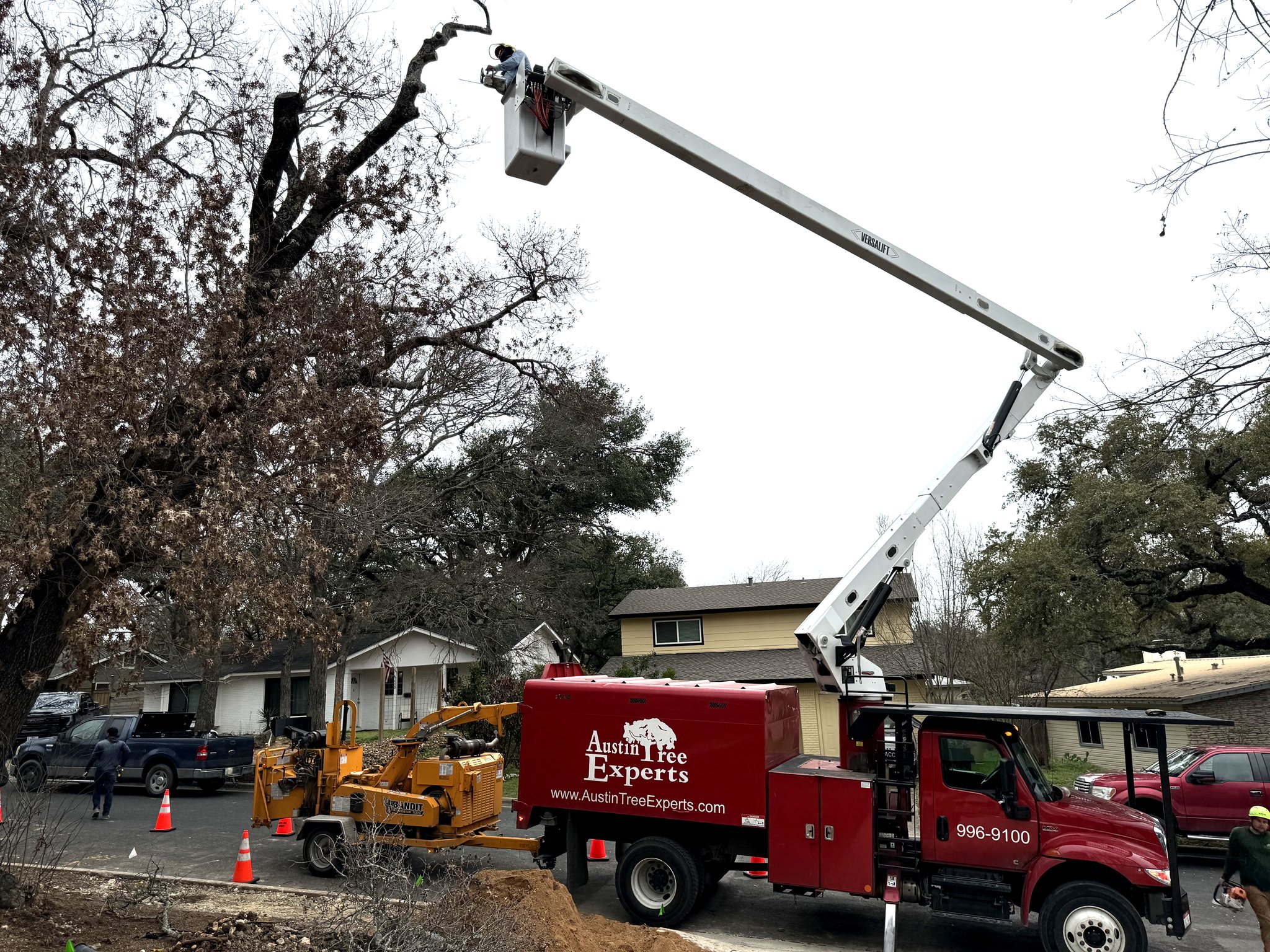
For trees where climbing is safe, we reach the canopy with our International Versalift 65′ bucket truck—or, when access is too tight for a truck, with a Platform Basket 18.6M tracked aerial lift that drives through a 36-inch gate into the backyard. Either way, a Bandit 15” or 12” wood chipper handles debris as it comes down, and our Switch-N-Go roll-off trucks carry a 23-yard high-capacity chipper body on removal jobs so the crew stays productive without running material back to the yard mid-day.
Austin’s mix of shallow soils over limestone and expansive clay means root systems are often shallower than you’d expect, especially west of I-35. Add a drought-weakened root plate and a heavy canopy, and you have a recipe for sudden failure. If you suspect a tree on your property is hazardous, don’t wait—contact us for a risk assessment before the next storm.
Sick Tree Removal
Knowing when a tree can be salvaged and when it’s time to cut losses can be a complicated and emotional decision. We have the expertise to talk you through your options so you don’t remove trees unnecessarily or waste efforts treating trees beyond a threshold of recovery. Sometimes a tree that looks terrible can be brought back with the right care program—deep root fertilization, targeted pest management, or AirSpade soil decompaction to restore the mycorrhizae and root-flare health the tree depends on. Other times, a tree that still has green leaves is already past the point of no return due to internal decay or root failure.
For oaks showing signs of decline, it’s especially important to get a proper diagnosis before removing. Oak wilt can spread through connected root systems of live oak and red oak, and removing an infected tree without understanding the underground situation can actually accelerate the problem. Post oak in decline often points to hypoxylon canker colonizing the heartwood. Cedar elm failures frequently trace to drought stress and bark borers. Our arborists evaluate the whole picture—root flare condition, cambium dieback, and species-specific pathogens—before ever recommending removal.
Stump Removal
Removing stumps can be as complicated as removing the tree itself. We run three stump grinders for different scales: a 40 HP Bandit SG40 that fits through a standard backyard gate, a 75 HP Bandit SG75 that grinds below grade on large heritage stumps, and a 40 HP Top Notch .38 Special so two crews can grind in parallel when a job calls for it. If the entire root ball needs to be pulled from the ground, our Yanmar SV100 excavator with log grapple handles the extraction. If you’re having a tree removed and want the stump taken care of at the same time, we can usually offer a better price on the stump grinding since our equipment is already on site.
Construction Sites & Tree Removal Permits
If you have a construction site in the planning or execution phase, we can help you get a permit to remove trees. Austin Tree Experts has experience with virtually every local jurisdiction’s tree ordinance. The City of Austin requires a permit to remove any protected tree (19 inches or larger in diameter), and other municipalities in the metro area have their own thresholds. Not sure which rules apply to your property? Use our Jurisdiction Finder tool.
Our consulting arborists—led by an ISA Board Certified Master Arborist—prepare the reports that cities require before issuing a removal permit: tree surveys, canopy impact assessments, ANSI A300-based tree protection plans, and mitigation plans. We also handle mitigation plantings if your permit requires replacement trees. For a complete picture of what we offer on job sites, visit our Construction Site Tree Services page.
How Much Does Tree Removal Cost in Austin?
Like tree pruning, cost varies greatly depending on tree size and location. Very small trees sometimes cost very little, especially if we’re also replanting a new tree. Large hazardous trees can be very expensive. Most trees fall between $800 and $3,000 in a typical suburban setting. For large trees, the structural condition plays a big role—a sound tree that can be conventionally climbed costs less to remove than a compromised tree that requires crane work. In some cases, a cabling and bracing intervention can extend a mature tree’s useful life for years and defer a removal that would otherwise be due now.
We provide free estimates for all tree removal work. Our arborist evaluates the tree, the access, the equipment needed, and the disposal logistics before putting a number together. Call (512) 996-9100 or request an estimate online.
Frequently Asked Questions About Tree Removal
Do I need a permit to remove a tree in Austin?
In the City of Austin, you need a permit to remove any protected tree with a trunk diameter of 19 inches or more at 4.5 feet above ground. Heritage trees (24 inches and above) have stricter protections and may require mitigation plantings. Other jurisdictions in the metro area—Round Rock, Cedar Park, Pflugerville—have their own thresholds. Our arborists handle the permitting process and can prepare all required documentation. Use our Jurisdiction Finder to check your property’s rules.
Does tree removal include the stump?
Tree removal and stump grinding are typically quoted separately, but we offer a discount when both are done at the same time since our equipment is already on site. If you want the stump removed, let your arborist know during the estimate so we can include it in the proposal.
Can a declining tree be saved instead of removed?
Sometimes, yes. A tree that looks rough may respond well to a targeted care program—fertilization, pest treatment, or soil improvement. Other times, internal decay or root failure means the tree is past recovery. Our arborists assess the whole picture before recommending removal. If there’s a reasonable chance of saving the tree, we’ll tell you. We’d rather help you keep a healthy tree than remove one unnecessarily.
What happens to the wood after removal?
All debris is hauled back to our yard at 15527 FM 969 in Austin, where we process it into mulch and compost. If you have a large tree with quality wood—like pecan or walnut—we can discuss options for milling or keeping the wood. Otherwise, we handle complete cleanup so your property is left clean.
Can you plant a new tree where the old one was?
Yes. Once the stump is ground down, we can plant a replacement tree in or near the same location. We’ll help you choose a species suited to Central Texas conditions—soil, sun exposure, and available space. In many cases, permit requirements actually mandate replacement plantings.
What’s the best time of year for tree removal in Austin?
Dormant season—late fall through early spring—is ideal when there’s flexibility. Leafless trees weigh less and are easier to rig, the ground is firmer for equipment, and our schedule is generally more open. But urgency trumps timing: a hazardous tree should come down when it’s flagged, regardless of season. For oak species specifically, avoid February-through-June pruning or removal to reduce oak wilt transmission risk—this is the one hard restriction driven by disease rather than convenience.
How long does a tree removal take?
Most residential removals run half a day to a full day on-site, plus cleanup. A standard 40-foot tree in an accessible yard is typically a 3-5 hour job including debris hauling. Large heritage-sized trees, trees requiring crane work, or removals with difficult access (tight spaces, steep slopes, power lines) can stretch into multiple days. Once the crew is scheduled, most jobs are completed in a single visit.
Is tree removal covered by homeowners insurance?
Routine removal of a live or declining tree is usually not covered—insurance treats it as property maintenance. Coverage typically kicks in when a tree falls on an insured structure during a covered event (windstorm, ice, lightning). In that case most policies cover the damage to the structure plus the cost of removing the downed tree, often up to a per-tree cap of a few hundred to a few thousand dollars. Check your specific policy, and if a tree has already fallen, document it with photos before we arrive.
Related Tree Services
- Stump Grinding — remove the stump after the tree is down, with three grinder sizes for any job
- Tree Planting — replace removed trees with native and adapted species for Central Texas
- Arborist Consulting — tree risk assessments, removal permits, and professional reports
- Construction Site Services — permitted removals, tree protection plans, and ordinance compliance
- Tree Care — sometimes a declining tree can be saved with the right care program
- Our Fleet — see the full list of trucks, chippers, grinders, and attachments we bring to every job
- All Services — explore everything Austin Tree Experts offers
Get a Free Tree Removal Estimate
Our Certified Arborists provide free on-site evaluations for tree removal in Austin and the surrounding area. We assess each situation and provide a detailed proposal covering equipment, timeline, and cost.
Call us today: (512) 996-9100