

Oak Wilt Treatment in Austin
Oak wilt is the most significant tree disease in Central Texas. It kills red oaks quickly—often within weeks—and causes a slower decline in live oaks that can take months to years. Austin Tree Experts has extensive experience diagnosing, treating, and managing oak wilt across the Austin metro area. Our approach combines fungicide injection, ongoing tree care, and proactive monitoring to give your oaks the best chance of survival.
Diagnosing Oak Wilt: Our Protocol Sets Us Apart
Accurate diagnosis is the foundation of effective oak wilt management. Our protocol involves multiple site visits, photographic documentation, and careful observation of symptom progression over time. We recommend that homeowners photograph their oak trees 3 to 4 times per year to track changes in canopy density, leaf color, and overall vigor. These baseline images are invaluable when symptoms first appear—they help us distinguish oak wilt from drought stress, hypoxylon canker, bacterial leaf scorch, and other conditions that can mimic the disease.
Challenges With Diagnosis
Oak wilt is notoriously difficult to diagnose in its early stages. Live oaks can carry the fungus for months before showing obvious symptoms, and the pattern of leaf drop can look similar to seasonal stress, especially during Austin’s drought-prone summers. Red oaks are somewhat easier to identify because they decline rapidly, but by the time symptoms are obvious the tree may already be past the point of treatment. Laboratory testing can confirm the presence of Bretziella fagacearum (reclassified around 2017 from its long-standing name Ceratocystis fagacearum after genetic analysis placed it in a separate genus), but false negatives are common because the fungus is not uniformly distributed within the tree. This is why we rely on a combination of visual assessment, site history, and pattern recognition rather than a single test.
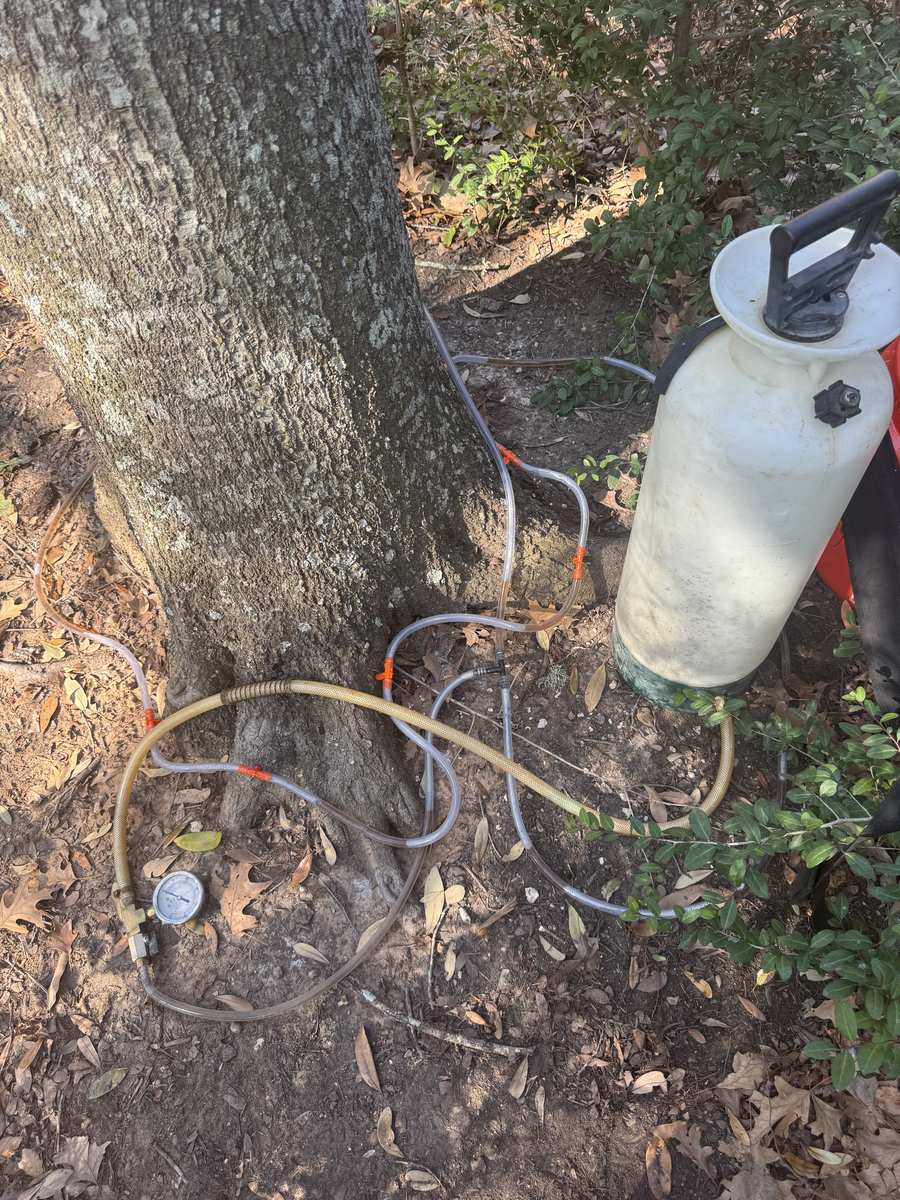
Injection Treatments
We treat oak wilt with propiconazole fungicide delivered directly into the tree’s vascular system. Two methods are available:
- Macro-infusion — Uses pressurized injection equipment to deliver larger volumes of propiconazole through ports drilled into the exposed root flares. Macro-infusion is faster and well-suited to large trees or sites with many trees to treat. Before the injection itself, we typically expose the root flare with an AirSpade so the ports go into sound, vascularly active tissue rather than buried bark.
- Micro-injection — Delivers the same propiconazole in smaller, more precisely targeted doses through individual injection points. This method is more labor-intensive but can be preferred for certain tree sizes and conditions.
Both methods deliver an equivalent amount of fungicide—the choice depends on the specific tree and site conditions. Treatment typically needs to be repeated every 12 to 18 months, and each visit includes an inspection by the treating arborist to monitor the tree’s response and adjust the plan as needed. For healthy oaks in active oak-wilt zones, we also offer preventive treatments (foliar and soil applications from our 600-gallon tree sprayer) as part of a broader care program.
Good Tree Care
Monitoring and maintaining tree condition is the best starting point for oak wilt management. Healthy, well-maintained trees are more resilient to infection and respond better to treatment. Our oak wilt management plans typically include fertilization, proper mulching, and ongoing health assessments. A dedicated arborist is assigned to manage each oak wilt case, ensuring continuity and personalized attention through the treatment cycle.
Trenching & Deep Root Systems in the Hill Country
Oak wilt spreads through connected root systems—live oaks within 50 to 100 feet of each other often share root grafts that allow the fungus to move underground from tree to tree. Trenching disrupts these root connections and creates a barrier to stop the disease from advancing to healthy trees.
In the Austin Hill Country, deep root systems growing through limestone fractures make trenching more complex. Roots can travel through cracks in the bedrock well below the depth of a conventional trench. Our arborists evaluate the geology, tree spacing, and root connection patterns before recommending a trenching plan. In some cases, a combination of trenching and air-spade work is needed to effectively isolate infected trees.
Consulting & Drone Surveys
For larger properties, neighborhoods, or HOAs dealing with an oak wilt outbreak, our consulting arborists can conduct comprehensive site assessments. We use drone surveys to map canopy condition across the property, identify trees showing early symptoms that might not be visible from the ground, and document the progression of the disease over time. This data helps us develop a strategic management plan that prioritizes treatment, identifies candidates for preventive injection, and determines where trenching is most effective.
Planting Trees in Oak Wilt Sites
Losing trees to oak wilt doesn’t mean you can’t replant. The key is species selection. We recommend planting resistant species in areas where oak wilt is present—cedar elm, chinkapin oak, Mexican white oak (Monterrey oak), and other species that are either immune or highly resistant to the disease. Red oaks should be avoided entirely in active oak wilt zones. Live oaks can potentially be replanted, but only after the disease has been contained and the infected root systems have had time to decay.
Frequently Asked Questions About Oak Wilt
What is oak wilt and which trees does it affect?
Oak wilt is a fungal disease caused by Bretziella fagacearum (previously classified as Ceratocystis fagacearum until genetic analysis prompted its reclassification around 2017) that attacks the vascular system of oak trees, blocking water and nutrient transport. Red oaks (Shumard, Spanish, blackjack) are most susceptible and can die within weeks. Live oaks decline more slowly but are still at serious risk. Other oak species in Central Texas are also susceptible to varying degrees.
How does oak wilt spread?
Oak wilt spreads two ways: overland via nitidulid beetles that carry fungal spores from infected trees to fresh wounds on healthy trees, and underground through connected root systems (root grafts) between nearby oaks. This is why pruning oaks between February and June is strongly discouraged—fresh pruning wounds attract the beetles during their most active season.
Can oak wilt be cured?
Oak wilt cannot be cured, but it can be managed. Propiconazole fungicide injections suppress the fungus within the tree and buy time for the tree to compartmentalize the infection. Treatment must be repeated every 12 to 18 months, and it works best when combined with good tree care—fertilization, mulching, and proper watering. Not every infected tree can be saved, but many respond well to treatment when caught early.
How do I know if my oak has oak wilt?
Symptoms in live oaks include veinal necrosis (yellow or brown patterns following leaf veins), progressive leaf drop, and thinning canopy. Red oaks show rapid wilting and browning from the top down. However, these symptoms can overlap with drought stress, hypoxylon canker, and other conditions. Professional diagnosis from a certified arborist is essential—treatment strategies differ significantly depending on the actual cause.
How much does oak wilt treatment cost?
Cost depends on the number and size of trees, the treatment method (macro vs. micro injection), and whether trenching is required. A single-tree injection is more affordable than a multi-tree management plan with trenching and preventive treatments. We provide free assessments and detailed proposals. Call (512) 996-9100.
When should I avoid pruning my oak trees?
Avoid pruning oaks between February and June, when nitidulid beetles are most active and can carry oak wilt spores to fresh wounds. If emergency pruning is unavoidable during this period, seal all cuts immediately with wound paint—the one situation where wound sealant is actually recommended. Outside this window, oak pruning is safe when performed by a qualified arborist.
Related Tree Services
- Tree Care & Fertilization — healthy trees fight oak wilt more effectively
- Arborist Consulting — site assessments, drone surveys, and management plans for oak wilt outbreaks
- Tree Removal — when an infected tree cannot be saved and poses a risk to neighboring oaks
- Tree Pruning — properly timed pruning to avoid oak wilt transmission
- Tree Planting — replacing lost oaks with resistant species
- All Services — explore everything Austin Tree Experts offers
Get an Oak Wilt Assessment
If you suspect oak wilt on your property, early assessment is critical. Our Certified Arborists provide free evaluations and develop treatment plans tailored to your trees and site conditions.
Call us today: (512) 996-9100